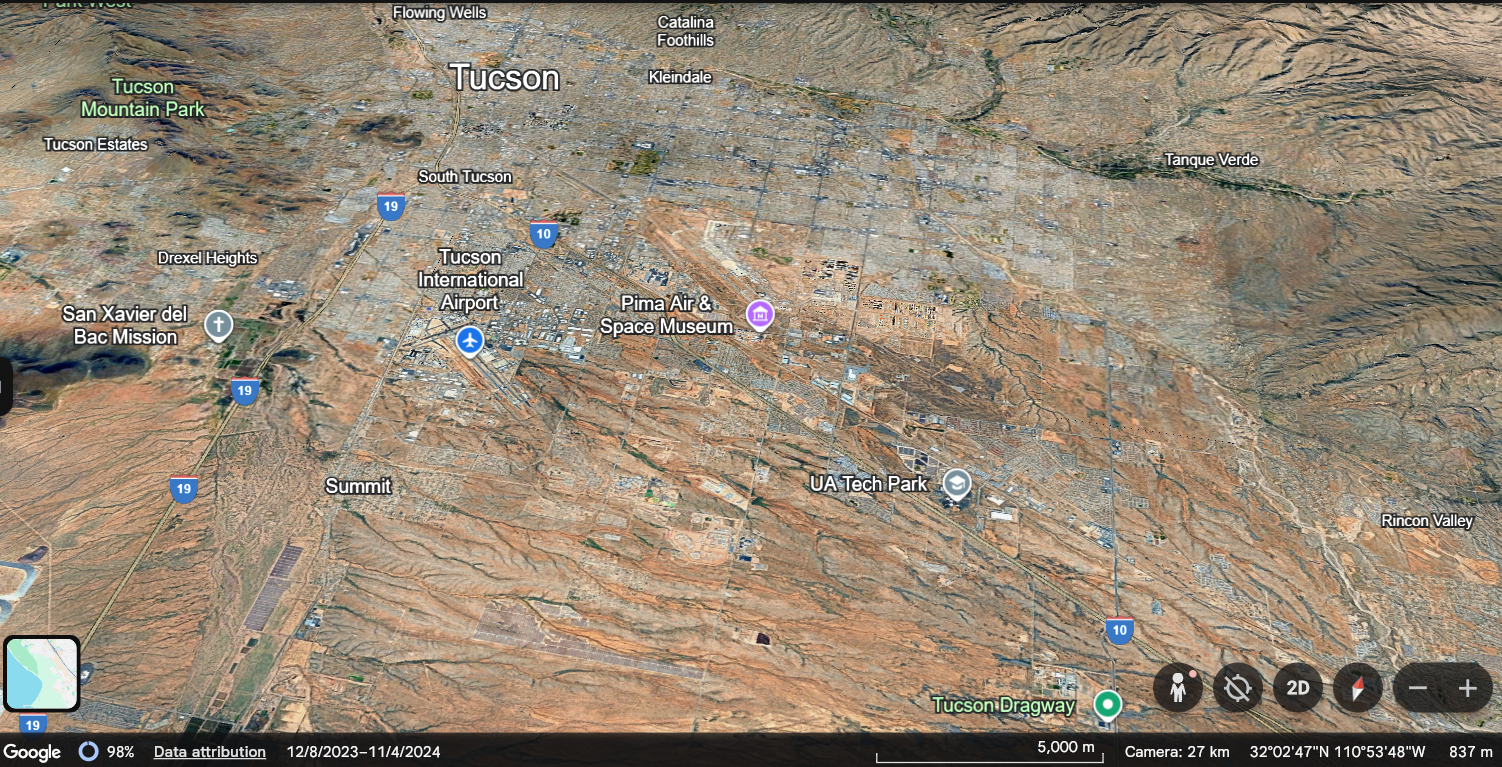
Riding along Valencia Road past the Pima Air & Space Museum is a striking departure from the organic curves of the mountains. This is a ride of straight lines, massive scale, and the heavy, metallic presence of aviation history. It feels less like a nature trail and more like a high-speed transit through a sprawling, open-air vault of human engineering.
1. The Corridor of Giants
As you head east on Valencia toward the museum, the landscape is dominated by the sheer scale of the aircraft. Even from the seat of a motorcycle, the tail fins of retired B-52 Stratofortresses and C-5 cargo planes loom over the perimeter fences like the sails of ancient ships. You aren’t just riding past a museum; you are riding through a “boneyard” atmosphere where thousands of tons of aluminum and titanium sit in silent, sun-bleached rows. The bike’s engine feels small and frantic against the backdrop of these silent, multi-engine behemoths.
2. The Hard-Pan Basin Geology
The ground here is the Tucson Basin floor—a flat, unforgiving expanse of Quaternary alluvium and “caliche.” Unlike the soft sands of the washes, the earth here is a hardened crust of calcium carbonate and sun-baked clay, so dense that it supports the immense weight of the aircraft without them sinking. On the bike, the road is a vibrating straight-edge that cuts through a sea of silver-gray dirt and creosote. The lack of vertical terrain makes the wind a constant factor; you’ll feel the “push” of the desert crosswinds as they sweep unobstructed across the flats.
3. The Industrial Scent and Sound
This is a sensory environment of “Oil and Dust.”
- The Smell: The air carries a distinct mix of dry desert heat and the faint, chemical tang of jet fuel and hydraulic fluid drifting from the active runways of nearby Davis-Monthan Air Force Base.
- The Sound: Your own exhaust is often drowned out by the thunder of active-duty A-10 Warthogs or F-16s performing touch-and-go landings. The physical vibration of a jet engine overhead adds a layer of “heavy metal” intensity to the ride that you won’t find in the quiet canyons of Saguaro West.
4. The Distant Mountain Framing
While the immediate terrain is flat, the horizon is a 360-degree theater of Arizona’s “Sky Islands.”
- To the North, the massive, craggy wall of the Santa Catalinas looms over the city.
- To the South, the Santa Ritas stand like a blue-tinted fortress.On the long, flat stretches of Valencia, these mountains provide a sense of perspective; they look like cardboard cutouts in the distance, underscoring just how vast the desert basin truly is.
5. The Metallic Mirage
In the midday heat, the “boneyard” creates a unique visual phenomenon. The sun reflecting off thousands of polished fuselages and cockpit glass creates a shimmering, silver mirage. The horizon seems to liquify into a sea of chrome. As you roll past the museum’s entrance, the bike feels like a modern scout passing through a graveyard of 20th-century titans—a ride that celebrates the intersection of desert survival and the raw power of flight.
Comparison: Nature vs. Machine
| Feature | Saguaro West (Nature) | Valencia Road (Machine) |
| Pavement | Curvy, dipping, “organic” flow | Long, flat, high-speed industrial |
| Key Landmark | Ancient green Saguaros | Sun-bleached B-52s & Cargo jets |
| Vibe | Meditative, cathedral-like | High-energy, military, technical |
| Surface | Gravel washes and granite dust | Hard-pan caliche and asphalt |